

Nathan Gardels is the editor-in-chief of Noema Magazine. He is also the co-founder of and a senior adviser to the Berggruen Institute.
From the 1950s through the 1980s, the journalist Liu Binyan fulfilled the kind of prominent role in China that the playwright Vaclav Havel did in Cold War Czechoslovakia, as a voice of conscience. Liu suffered many ups and downs, like China itself, alternatively persecuted by the government and, periodically, left alone to expose corruption in seminal reportage, including in his 1979 book “People or Monsters.”
The great respect accorded him throughout China during the early days of liberalization after the Cultural Revolution and the death of Mao derived from his courage in saying for so long what many believed and talked about privately but were afraid to say openly.
Liu was visiting the U.S. when the Tiananmen crackdown took place and never returned to China before he died in 2005. In January 1989, I published a long interview with him in the New York Review of Books about “the price China has paid” for suppressing so many truths that needed to be heard.
Today, a new trusted voice has appeared in China’s cyberspace and is rising to Liu’s stature — the virtual influencer Ying Li, known popularly as Teacher Li.
Li’s methodology is simple. In a media ecosystem dominated by the “all is well” narrative of the one-party state, he looks beyond the glittering images of bullet trains and awesome infrastructure achievements. As he told the Financial Times, “My work is about bringing to light the voices of ordinary people who are saying how things really are.”
Based in Milan to circumvent China’s “Great Firewall,” Li’s social media account on X regularly curates and publishes dozens of fact-checked, uncensored images and videos of daily life in Xi’s China sent to him through encrypted channels. More than 2 million followers in China access his site, “Teacher Li Is Not Your Teacher” with its handle @whyyoutouzhele, mostly through virtual private networks.
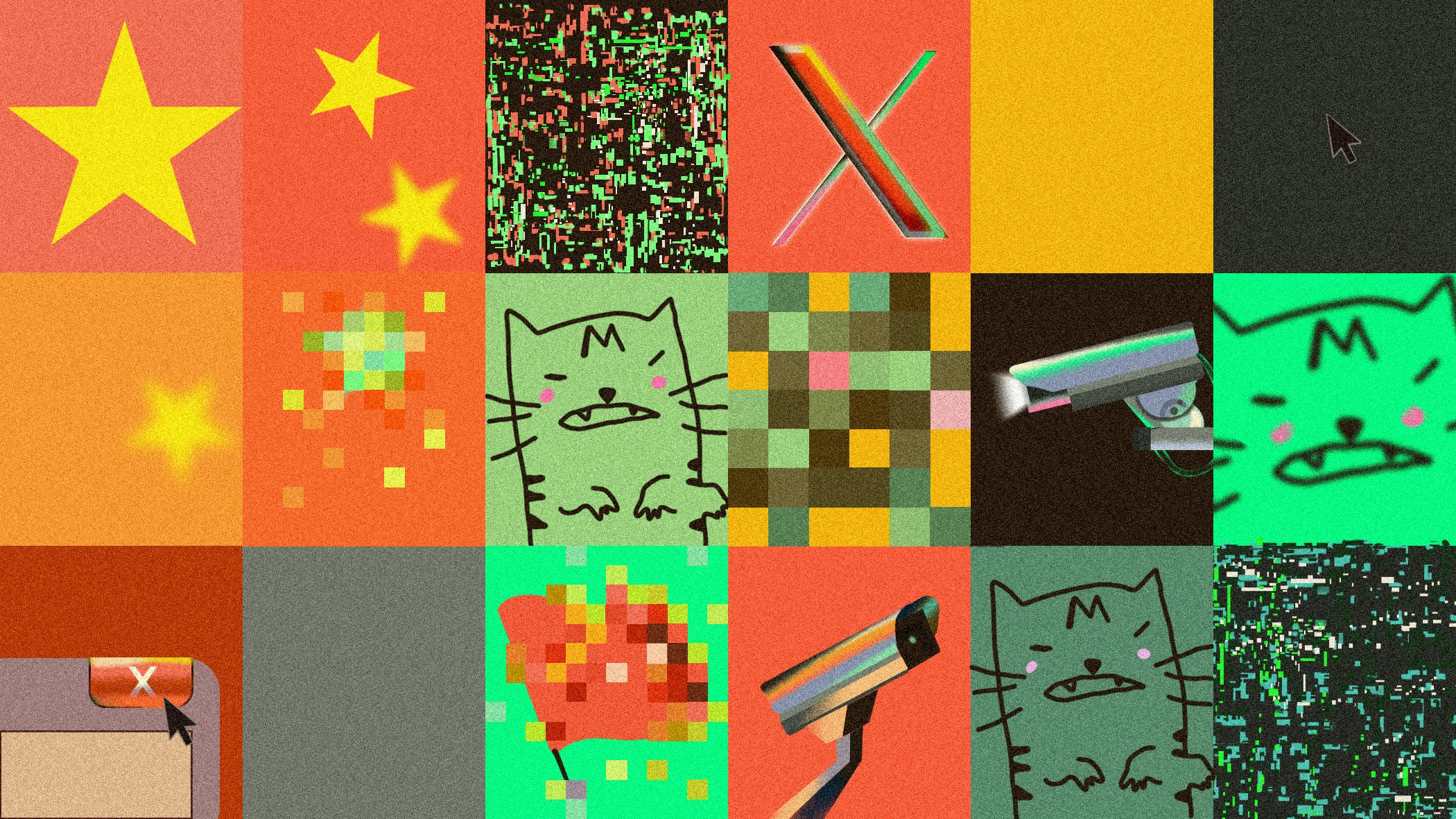
The avatar of his account is the drawing of a tabby cat that can be seen in the illustration above.
Though his Weibo accounts within China have been canceled some 50 times, Li and his savvy team have used tactics like rapid, redundant postings that appear continuously before censors can close in and setting up new accounts every time one is taken down.
“China is a low-trust society,” Li said. “Even among dissidents there is mistrust. The point of my work is to build trust — that is why we do everything. I think that makes me a new species of dissident.”
Like Liu before him, Li’s aim is not the overthrow of Communist Party rule, which he believes would only result in chaos, but bringing transparency and accountability to the system.
“There is a channel now between discontent and impact,” he says, “and I think this will continue to rise. As the cost of not speaking out becomes too high, it will drive people to speak out.” Indeed, this is precisely what happened in the famous “White Paper” movement that erupted against rigid Covid lockdown strictures in 2022, which brought Li to prominence. “Our work is about being ready for the tipping point,” he adds hopefully.
An Autonomous Civil Society
The sharp distinction in the West between state and civil society never developed in the same way in China. The Middle Kingdom did not experience the historical contest between religious and political authority in which each carved out its own autonomous sphere. China has always had a unitary state encompassing all of society, with no distinct realm outside its fold.
However, the kind of civil society associated with the West may well now be emerging. The system, which has managed to balance stability and change for so long, is being challenged as never before.
What is different for China today, compared to its more than 2,000 years of institutional civilization, is the advent of digital connectivity, which enables people to access essentially the same information as their rulers, despite the state’s broad hit-and-miss censorship practices. And it is here that the guiding anxiety of China’s top party officials, who are determined not to succumb to the fate of the Communist Party of the Soviet Union, appears misplaced. They are laboring under the power of the wrong metaphor.
As Xi and his colleagues see it, the Soviet party met its demise because of Gorbachev’s policy of “glasnost,” or transparent information. China’s leaders have thus concluded that the way to survive is to construct a narrative people are compelled to believe in by controlling what they are otherwise allowed to know. The reality is that the Soviet party collapsed precisely because of a similar effort to disguise reality with a narrative that didn’t square with people’s actual lived experience. When the lies were taken away under “glasnost,” there was nothing left.
In many ways, the Chinese party could not be more different. In China, the emperor does have clothes. The Party has demonstrably delivered for its people over the last several decades precisely by following Deng Xiaoping’s pragmatic dictum of “seeking truth from facts” instead of spinning reality.
Admitting mistakes — brought to their attention by activists and social media influencers — and fixing them, not covering them up, is what establishes governing legitimacy in the information age when everyone knows what’s what anyway. The old system of hierarchical control that could once impose an authoritative narrative is doomed by this democratization of information.
Just as the bourgeoisie created the space for civil society vis-à-vis royal absolutism in Europe, and just as women are the makers of a democratic public sphere vis-à-vis theocracy and patriarchy in the Islamic world, so, too, social networks may well be the makers of civil society in today’s China.
In a conversation in Beijing in March 2015 with China’s then-internet czar, Lu Wei, we discussed how to balance “freedom and order” in cyberspace. He quite openly acknowledged that in the absence of competitive elections, robust feedback on Weibo and other social media would serve as an important corrective to authority.
No one in the leadership misses the fact that, with hundreds of millions of netizens, China’s cybersphere is the new Tiananmen Square of modern times. While the authorities seek to maintain order online, they also fully recognize that the web can be a valuable feedback platform for the Party-state. Inevitably, it is already evolving as a key mechanism of “sousveillance,” or monitoring from below by the public.
The “tipping point” the influencer Ying Li hopes for is bound to come sooner or later in China, either through a push from below or through a loosened muzzle from above. Those intent on fortifying the Great Firewall and other means of suppressing expression should awaken to a truism of effective governance: Transparency and accountability are not the enemy of power, but the very source of its sustained legitimacy.
Correction: On May 8, 2026, this essay corrected Teacher Li’s full name. It is Ying Li.


