

Laura J. Martin is an associate professor of environmental studies and faculty affiliate in history at Williams College. Her book “Wild by Design: The Rise of Ecological Restoration” was published in 2022.
The first time I checked my work email in the bathroom, it didn’t feel like a concession. It felt like a tiny victory, a new efficacy in a crowded day. The internet had followed me into the most private of rooms. How did I end up there, responding to colleagues while the shower warmed, scrolling grim headlines on the toilet?
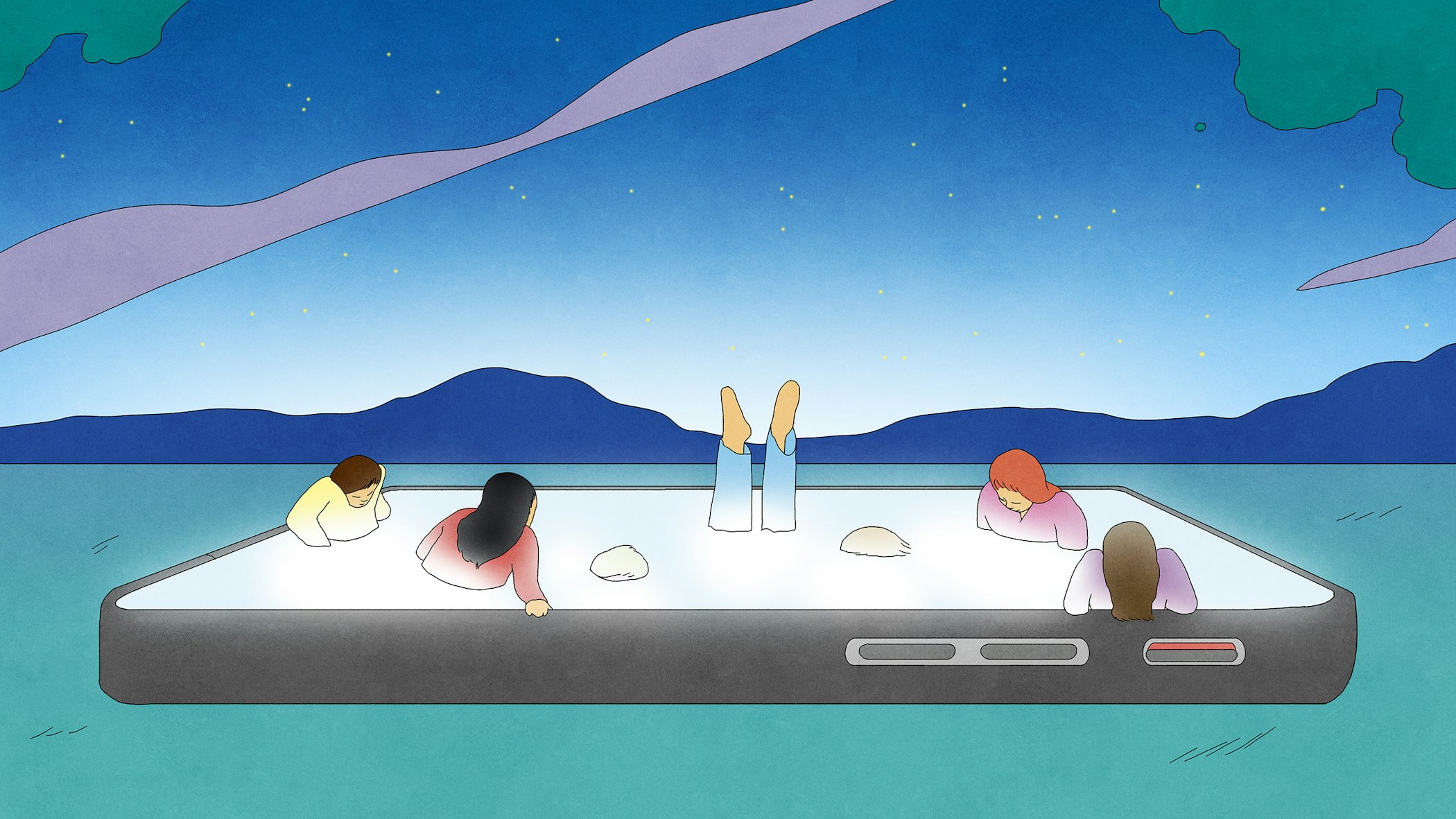
I ask this as someone of the hinge generation whose childhood was free of the internet and whose adolescence was tethered to it. I remember when going online took effort, and I remember, too, when that effort evaporated. The big change in the early 2000s wasn’t simply that more people started going on the internet. It was that the internet stopped being somewhere you went and became something you lived inside. The internet became an environment.
I was 14 when my family got dial-up. At the time, about a quarter of U.S. households had internet access. (Now, more than 90% do.) In those early days, logging on required ceremony. You had to negotiate with the people you lived with. We said things to each other like, “Can I have 10 more minutes?” and “Get off, I need to call Grandma.” Going online required permission. The modem sang its nervous hymn.
The internet arrived in my home as a window, an enchanted portal cut into ordinary domestic space. A window is fixed in place. “I’m going online” meant you were heading to a specific place in the house, along the lines of “I’ll be in my room” or “I’m going to the attic.” To peer into the internet, I had to sit in my parents’ maroon computer chair. To my left, through the non-metaphorical window, I could see telephone wires running down the street, carrying away my messages.
I was born into a world that contained telephones just as it contained stones and trees. The internet differed from the telephone in its unvoicedness, but they shared a familiar infrastructure. It was physical and placed. There was a here that somebody had connected with copper wire to a there.
Then came AOL Instant Messenger. It was an awful place for middle schoolers, but there we were anyway, a swarm of screennames in chatrooms, my own (PyRoAnGeL5) among them. Suddenly, school life ran on two channels, what happened at school and what happened at school at home.
Still, you could leave.
You could stand up, walk away from the computer, step back into your body and your house. In fact, you had to. Our digital lives were structured by departures.
“brb,” your friend would type. And like that, you waited for her to return to her family’s computer, a tower tucked under a laminate desk, which itself sat beneath a framed poster of Monet’s sunflowers in the dining room. Maybe she needed to use the bathroom. Maybe she was getting a glass of Sprite. Maybe her mother needed the phone line. You trusted she’d be right back. The initialism promised it.
It’s 1998. Your friend lives two blocks away, but you’re talking to her, and two other friends, and you can feel the strange thrill of it: You have stepped through a window into a place that isn’t quite a place.
That place began dissolving around 2005, the year I turned 21. Wireless routers spread through apartments and dorms. Laptops floated from room to room. No longer tethered to the wall, connectivity bled onto kitchen counters, coffee tables, the unmade bed that became a midnight workspace. Being online involved less ceremony and less permission-seeking. You didn’t step through a portal to go online so much as tilt open a screen, adjust to new light and enter the rushing stream. “I’ll look it up later” became looking it up in the hallway, halfway to the next thing.
Once oriented to fixed terminals, we began to reorganize our houses around dead zones and hotspots. We followed our devices’ sensory organs and learned a new physics, adapting to the way the microwave choked the 2.4 GHz band, the way the maple tree dulled the router’s reach, the way a closed door could be both privacy and attenuation. We remapped our environments.
Where the internet sat in the house became difficult to say. It felt less like a window and more like the weather, an ambient condition to which we adapted the movement of our bodies.
“I remember when going online took effort, and I remember, too, when that effort evaporated.”
With Wi-Fi, we invited the world into our homes. With smartphones, we inverted our homes into the world. I got my first smartphone in 2013, late enough that I had already formed adult habits and early enough to watch them be remade. The smartphone didn’t just make the internet portable; it made it proximate. We didn’t simply carry connectivity, we cradled it. We stroked it.
We began to speak to one another with our eyes lowered, our hands twitching when the screen flared like a shooting star. “I should respond to this,” we said, as if responding were not a choice but an obligation. The desktop computer had beckoned, yes, a glowing window into other worlds. But the phone was different. It buzzed against our thighs. It insisted.
The pandemic laid bare the world we had been drifting toward, one in which the home is the office, school, studio. In 2020 we rearranged furniture, searching for the lighting that most flattered our faces. We discovered which rooms echoed and which swallowed sound. I lived alone that first pandemic year, beaming my image across the country to family and friends. I ached for touch and I had no touch. I began carrying my phone from room to room.
That is when I began bringing the internet into the bathroom.
I became addicted to my phone’s sleek body, its vibrations and its flashes. I felt increasing disquiet at the thought of being disconnected, as if connectivity were not a service but a bodily need. I expected connectivity like I expected air.
As an environmental studies professor, I’ve spent my career studying how the built world reshapes the living one. We tend to treat the internet as an abstraction, something empty, placeless, limitless. But nothing about it is airy. The internet is heavy industry. It is cables laid across seafloor. It is warehouse-sized data centers cooled by river water. Every search query, every streamed video, every automated “I’m just following up” email rides on physical systems.
Inside servers and smartphones are materials mined from specific places: cerium from Bayan Obo in Inner Mongolia, cobalt from the Democratic Republic of Congo, lithium from Chile’s Salar de Atacama. These metals are often extracted by laborers with few protections working in exceptionally dangerous conditions.
Even before the 2022 launch of ChatGPT and the subsequent AI surge, data centers were already consuming about 1% of the world’s electricity. Morgan Stanley projects data centers will produce 2.5 billion metric tons of carbon dioxide equivalent by 2030. The term “cloud” conjures something weightless, ephemeral, unowned. The cloud is none of these things.
But extraction and emissions are not the only environmental changes wrought by the internet. Connectivity has remade how we perceive our environments and how we move through them. It has changed what it feels like to live in a place, how we navigate rooms and streets, how often we are alone. And all of this happened without dispelling the illusion that the digital is limitless and free of place.
We speak of “screen time” as if time were the only axis. But the spatial axis matters, too.
Ambient connectivity has trained our bodies in the protective hunch of the scroll, the twitch of the hand opening toward a notification, the omnipresence of vibration. The problem isn’t only how much time we spend online. It’s how we move in the spaces we’ve built for online life and what kinds of freedoms we’ve lost.
If the network follows the body through the house, what spaces can we build to let the body be alone? What would it mean to limit not only screen time, but screen space?
It’s tempting to romanticize a childhood without devices, a bike ride without a GPS trace. What I miss about the corner-desk internet of my youth isn’t purity. It’s friction.
That earlier internet had constraints that protected me. Being online meant being somewhere shared. The household computer forced the internet into relation with the dinner table, the phone line, the ordinary fact of coexistence.
The smartphone does the opposite. It carries the elsewhere to the bathroom, the library, the date, the bed. The home that once defined the end of the workday now extends it. My students are experts at maintaining two conversations at once, one in the room and one on the screen. Many are exhausted by it. We are all subjects in a decades-long experiment designed to monetize our attention.
“With Wi-Fi, we invited the world into our homes. With smartphones, we inverted our homes into the world.”
Every now and again I try to treat my devices as fixed in space. I resolve to use my laptop only at my desk and my phone only at the kitchen counter where it recharges. It’s a useful exercise, and a humbling one. It lets me feel with my body how I am captive to connectivity. I am frustrated when the internet feels like a window: I’ve grown accustomed to weather.
After minutes or hours, I inevitably fail, unplugging my phone as I walk out the door.
Some people pursue periodic extremes, locking up their devices for a “digital detox.” One can pay for a lavish digital retreat. But this all-or-nothing approach to being online fails to offer us a model for how to live in the middle, how to use the internet as a tool while maintaining the freedom of our bodies.
The problem, I am starting to think, is not only that we use our phones in the bathroom, but that we imagine that socializing, knowledge production, politics and creativity can be achieved outside of physical space. We make the same mistake with generative AI that we make with the internet when we treat it as a nowhere rather than a somewhere. We fail to acknowledge that the virtual operates within — and not beyond — the spatial, material world.
It’s the difference between C-3PO from “Star Wars” and Samantha from Spike Jonze’s “Her,” the one a comically, but necessarily embodied humanoid, the other quite literally transcendent. Maybe we used to measure intelligence through physical competences like the ability to navigate doors and stairs, to read a gesture, to hold eye contact, but today we measure it by its ambient ever-presence.
We no longer think a robot is intelligent just because it can move in a world built for bodies like ours. Large language models (LLMs), in our imagination, are conversational beings without bodies, without any friction of environment. We speak to them as if they were somewhere nearby, and yet they are not anywhere our imaginations can place. And so we begin to accept the strange premise that intelligence might exist outside of the physical world, floating above the constraints that make human life legible.
Yet intelligence is environmental.
My colleague at Williams College, Joe Cruz, notes that for an AI to strike us as authentically intelligent, it will have to be embodied, because many of the features we value in human (and animal) intelligence arose from the task of keeping a body alive as it moves through shared space. We recognize dogs as intelligent, for instance, in part because they have facility in our built and social spaces, communicating through shared emotional expressions, having evolved to live within our environments. Some cognitive scientists argue that intelligence cannot be made sense of in isolation from body and environment at all.
The sci-fi image of the floating brain that finds a body and learns to walk (or to love) has the steps reversed. We learn through our bodies; we sense the world, make decisions about it and act within it. Intelligence that is disembodied will not seem like intelligence to us.
And yet, in Silicon Valley, the opposite vision holds sway. Powerful people, including tech experts and many of our elected officials, believe that with LLMs, we will find a better way of living together, a better way of governing our shared environment.
Sam Altman, the CEO of OpenAI, has argued that AI acceleration will usher in an “Intelligence Age” of “unimaginable” and “shared” prosperity and “astounding triumphs” like “fixing the climate.” Deep learning, he explains, is an algorithm that can truly learn the rules behind any distribution of data. The more compute and data available, the better it can help people “solve hard problems.”
Altman’s vision collides with basic truths of how people live. We care for places because we inhabit them. Love of place arises through our bodies as much as our minds.
But those committed to disembodied intelligence reach for a different solution: total representation. If the model cannot dwell in the world, the world must be made to dwell in the model as a “digital twin,” rendered at ever finer resolution, until environment becomes data and data becomes environment.
Argentinian author Jorge Luis Borges’ parable “On Exactitude in Science” imagines an empire that produces a map the exact size of the territory. It is a useless tool, one that becomes territory itself. “In the Deserts of the West,” Borges concludes his story, “there are Tattered Ruins of that Map, inhabited by Animals and Beggars.”
“What would it mean to limit not only screen time, but screen space?”
Those dreaming of a nascent cognitive revolution are imagining that Borges’ one-to-one map will be finally useful — that if we just feed enough text, enough human knowledge, into the machine, it will comprehend the world in a way we never can.
Even if we had the time, labor and energy to attempt this, why would we? Why not put that effort into talking to each other?
The alternative is an increasingly familiar solipsism. A solipsistic person believes the self is the only reality. Other minds, other bodies, may as well be an illusion.
Today’s internet bends us toward solipsism. We no longer imagine ourselves to be placing our images and our voices into the internet. We imagine ourselves — our physical beings — to be living within it. We imagine the internet to be our environment.
In “Trick Mirror,” journalist Jia Tolentino warned that the internet, once imagined as a space of freedom, had become a mechanism for surveillance, performance and commodification. Online life encourages self-optimization and branding at the expense of connection. “In physical spaces, there’s a limited audience and time span for every performance,” Tolentino writes. “Online, your audience can hypothetically keep expanding forever, and the performance never has to end.”
Tolentino focused on time, but this internet is an endless stage, too, one with no wings, no exit, no place to step off and be alone again.
“brb” once acknowledged departure and faith in return. It reminded us of the body behind the screen. Now, we are infinitely available, and AI is sold to us as the tireless and needless assistant. But our bodies continue to live in the world with stubborn persistence, despite Silicon Valley’s dream of the immortal avatar, the ability to upload our essence into a durable machine, which is a dream of escaping death and environment alike.
Most of the questions worth asking are not about how to transcend the environment, but how to inhabit it. How to live together in shared space.
Many social, historical and economic forces led me to check my work email in the bathroom. Among them is the way we have come to imagine the internet not as a place we go, but as a space we inhabit. We make sense of abstract experience through bodily metaphors grounded in orientation and sensation: Up is good, down is bad, warmth is affection, weight is importance. These metaphors shape how we act and what we value.
Window, weather: Change the metaphor and you change the possibilities for thought and action. If the internet once taught us to say “brb,” perhaps the work ahead is to recover that ethic of interruption, to remember the body in a room, waiting to return.
