


Christian Elliott is a science and environmental writer based in Illinois. His work has appeared in National Geographic, Smithsonian, Science, Undark and Scientific American, among other publications.
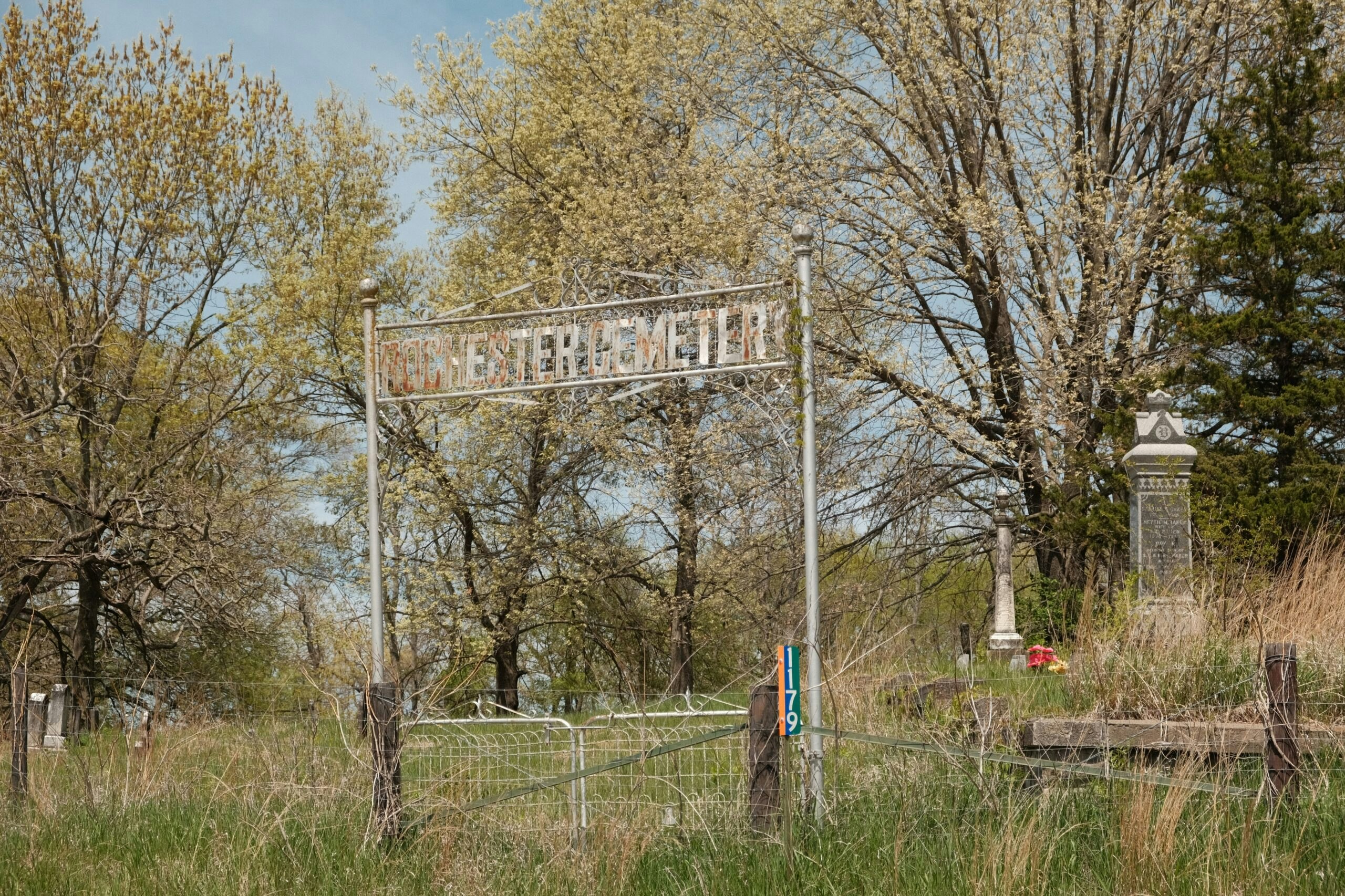
ROCHESTER, Iowa — If you take a road trip across Iowa, you’re likely to see fields of corn and soybean crops blanketing the landscape, one after the other across 23 million acres, or some 65% of the state. But turn off a gravel road near the Cedar River in the rural southeast and walk through an ornate rusted arch, and you will find yourself in another world.
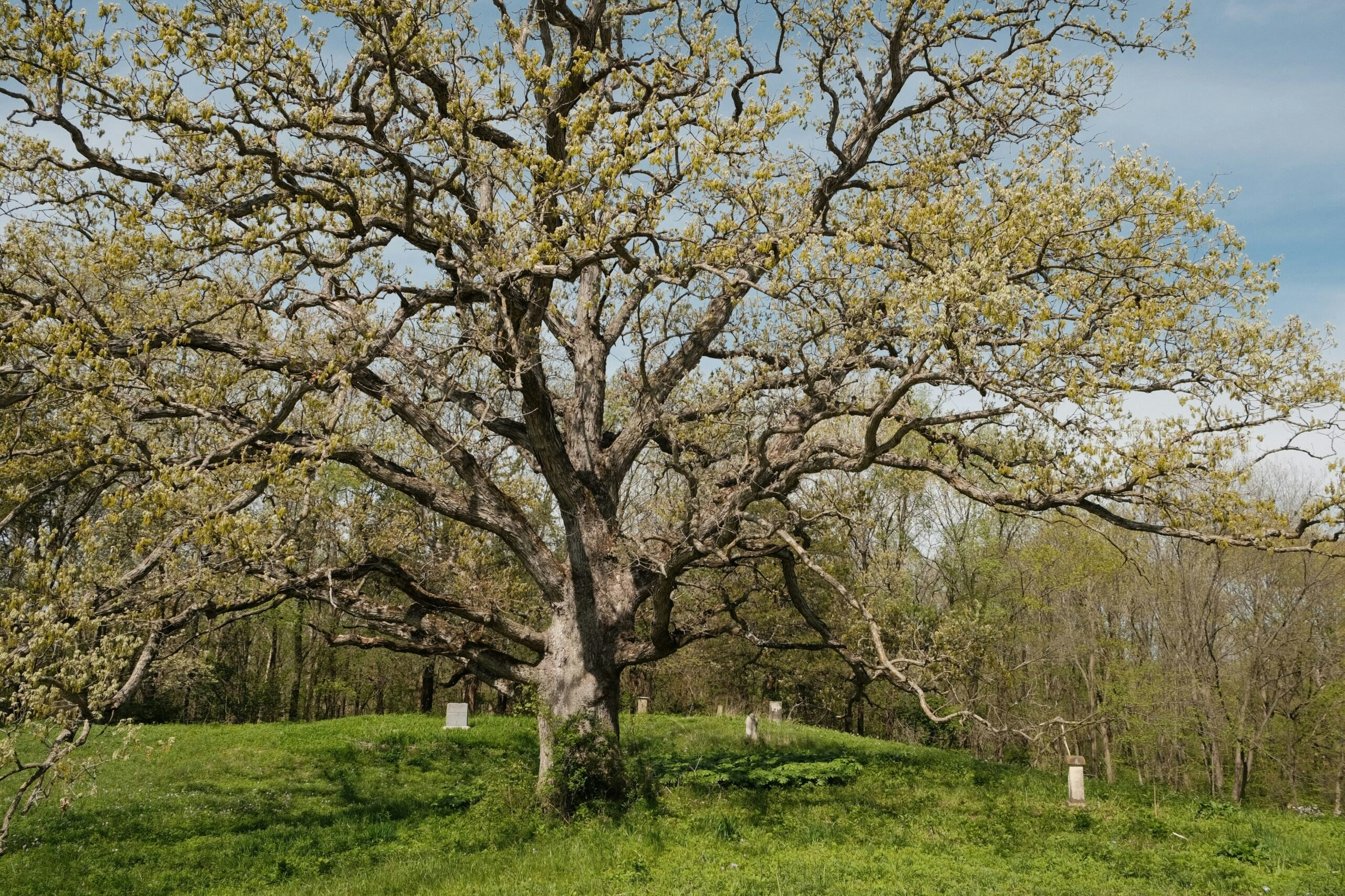
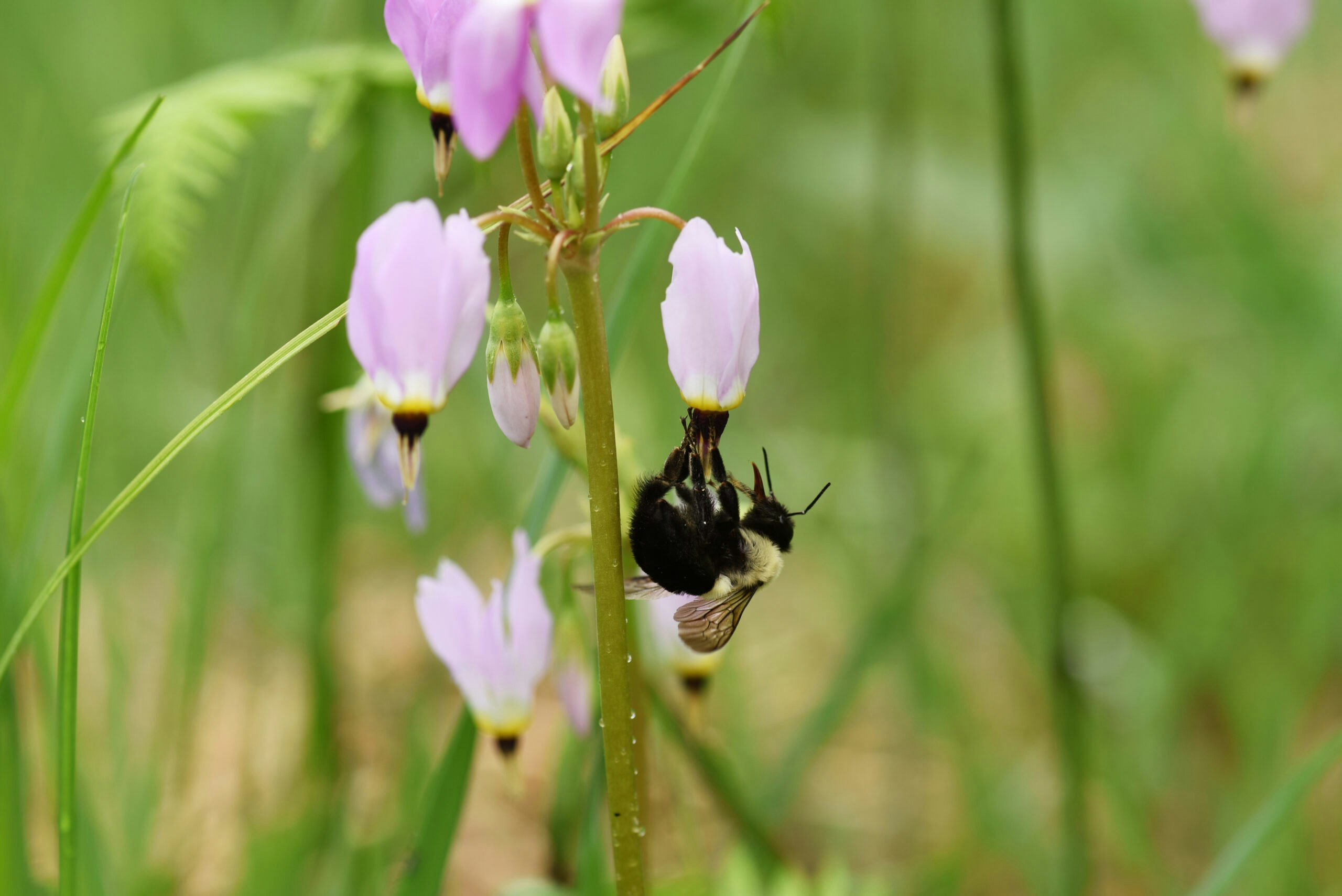
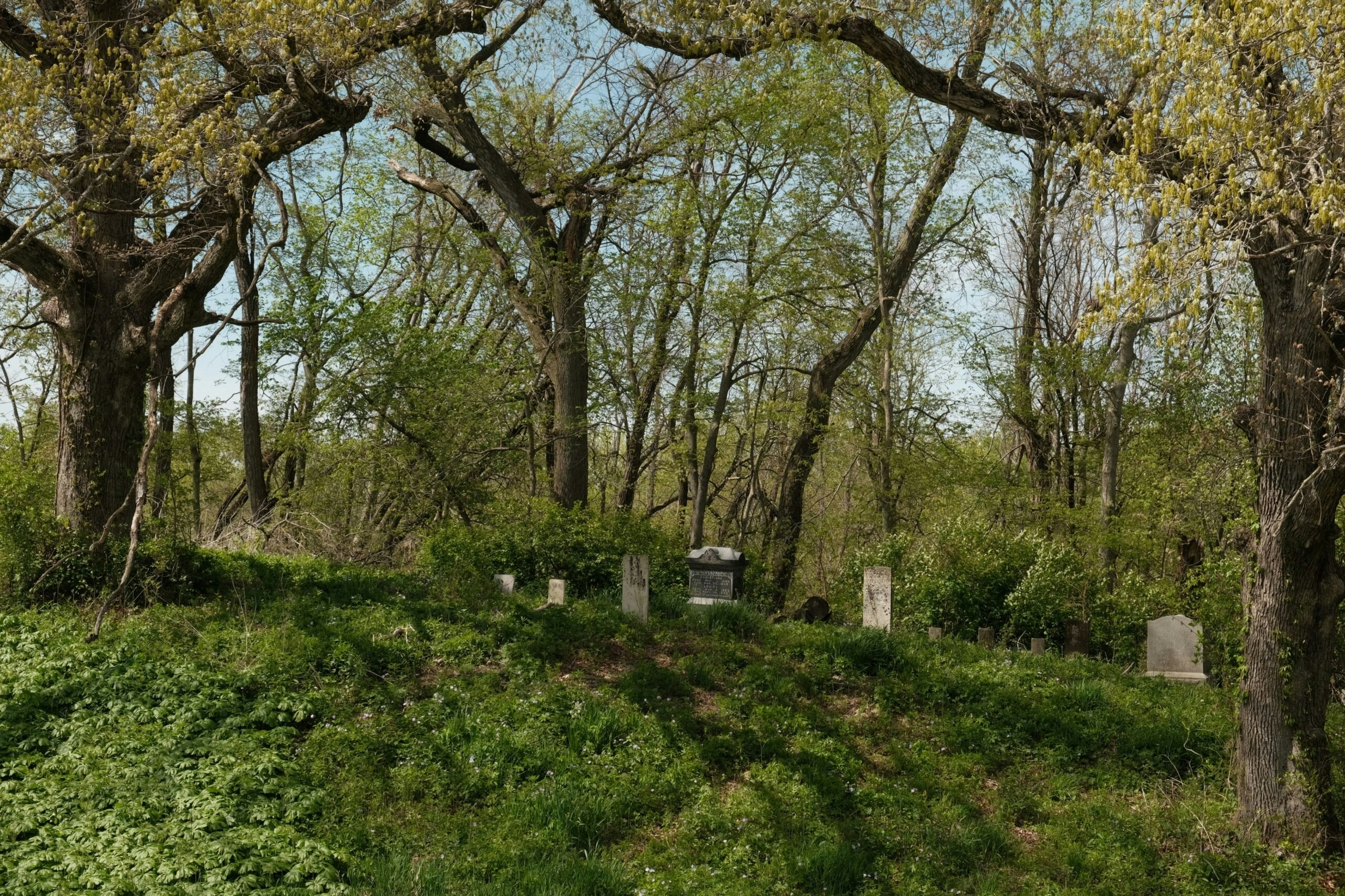
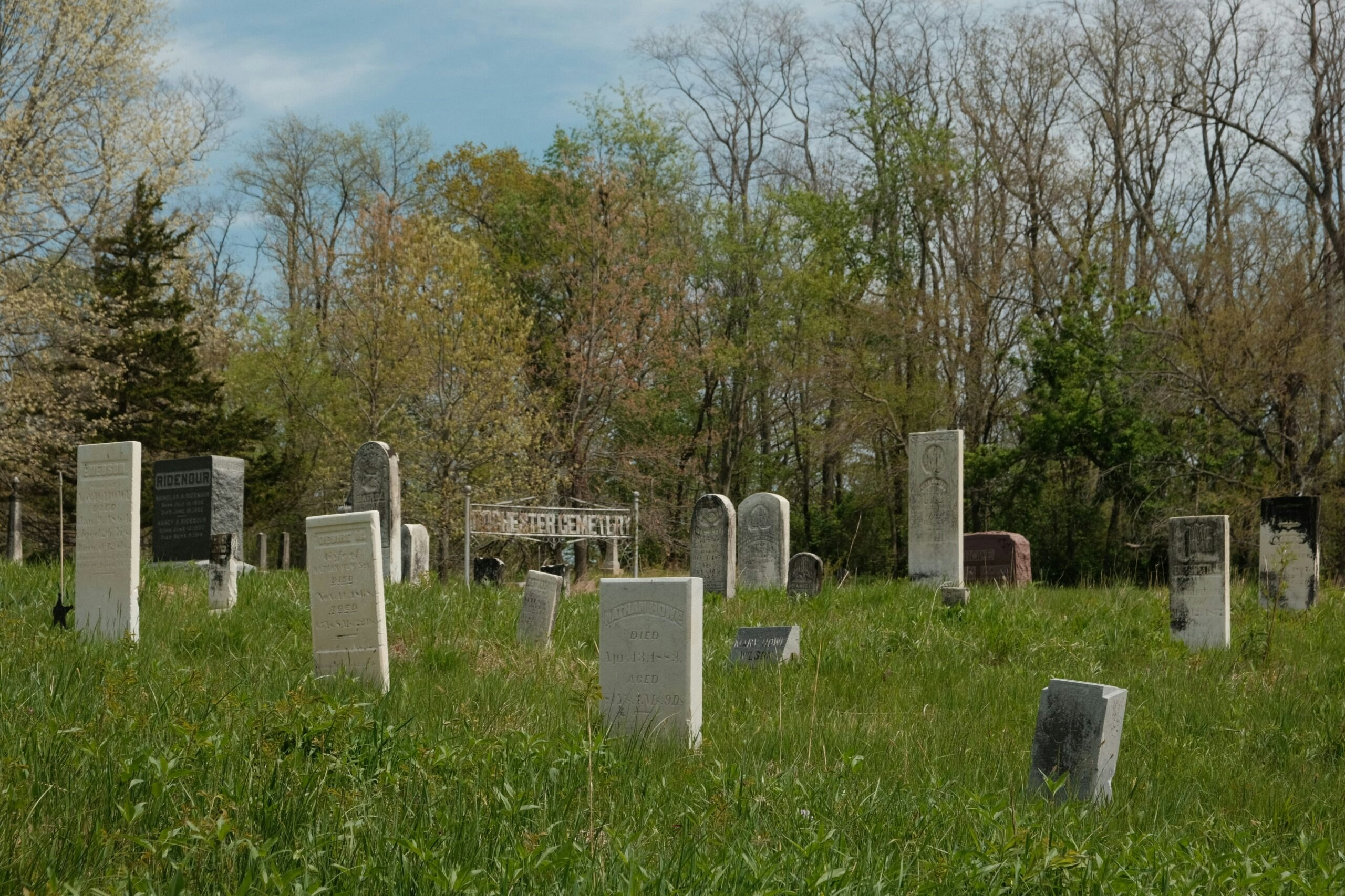
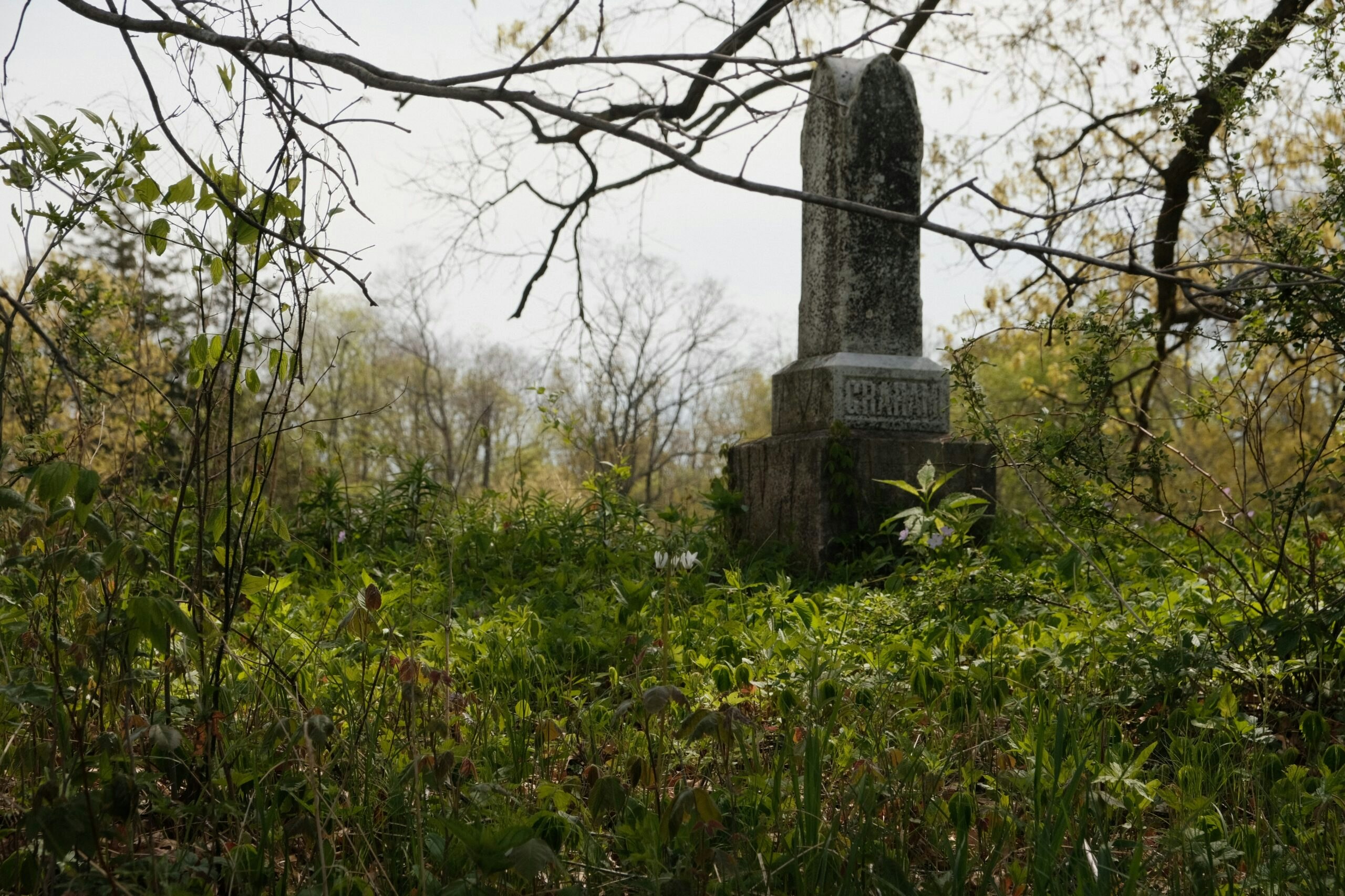
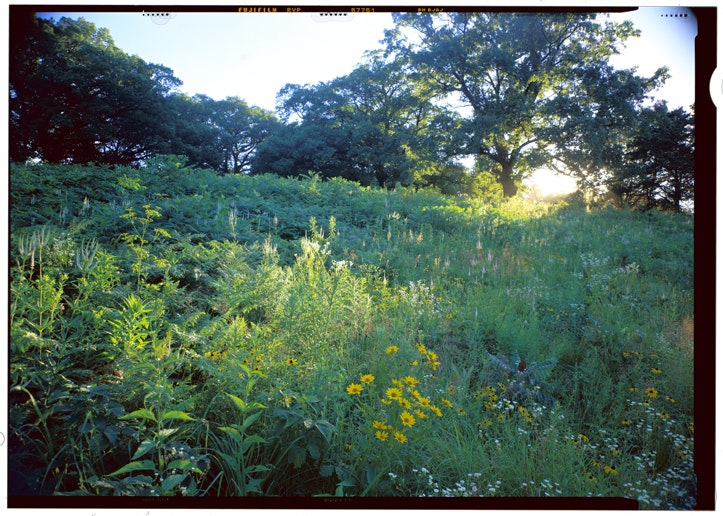
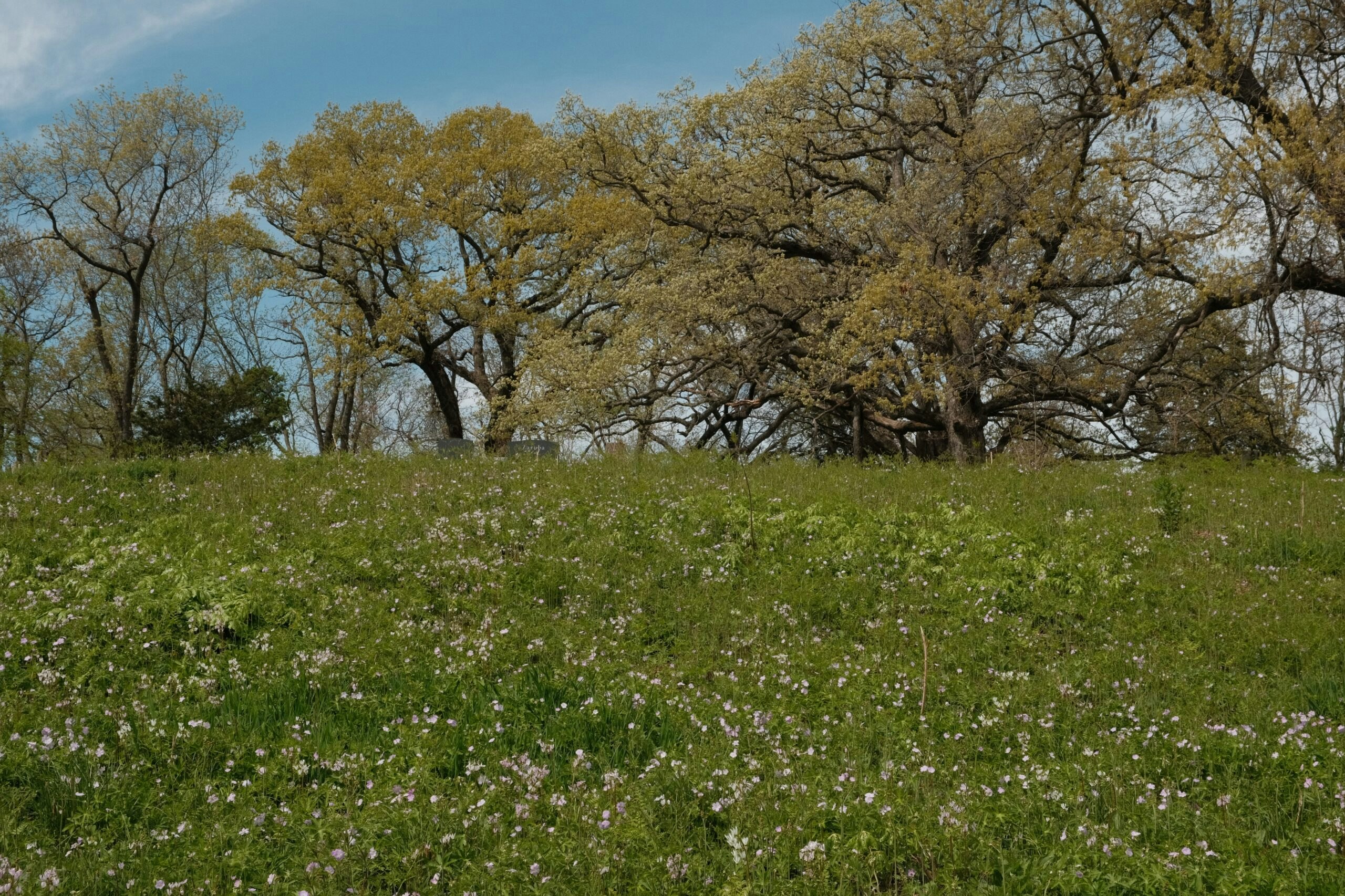
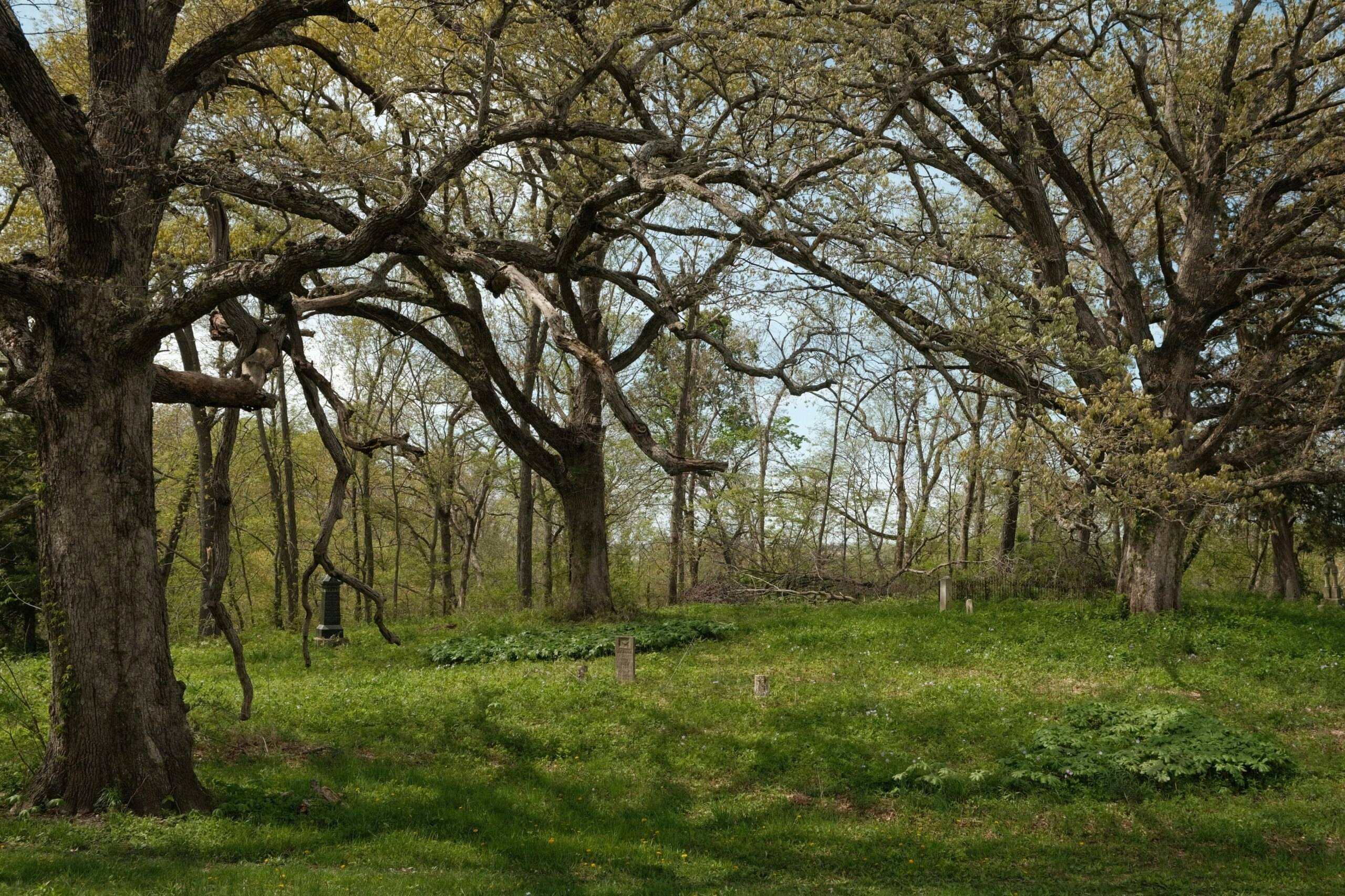
Rochester Cemetery is not just an active cemetery. It’s a remnant of a once-common sight in Iowa, the place where tallgrass prairie and woodland meet. Faded, crumbling headstones dot its 13 hilly acres. The biggest oaks I’ve seen in my life — gnarled, centuries-old red, black, burr and white — tower over them, keeping watch. And otherwise engulfing the stones is a sea of prairie grasses: big bluestem, Indiangrass, switchgrass. On the right spring day, there are more blooming shooting stars here — with their delicate pink downturned heads nodding in the breeze — than may exist anywhere else in the state.
The cemetery itself dates to the 1830s, just after the Black Hawk Purchase added Iowa to the Union. But today, Rochester is special because it contains one of the rarest ecosystems in the world: oak savanna. Under a few massive trees, prairie plants sequester carbon, prevent erosion and provide key habitat for endangered wildlife like Monarch butterflies and rusty-patched bumblebees — ecosystem services desperately needed across the Midwest.
Before European settlement, tallgrass prairie covered 80% of Iowa. What remains serves as critical seed banks and blueprints for future restorations. But the continued existence of remnants like Rochester is tenuous in this land where corn is king, and it depends on the stewardship of individuals with very different ideas about what and who the land is for — and how it should be managed.
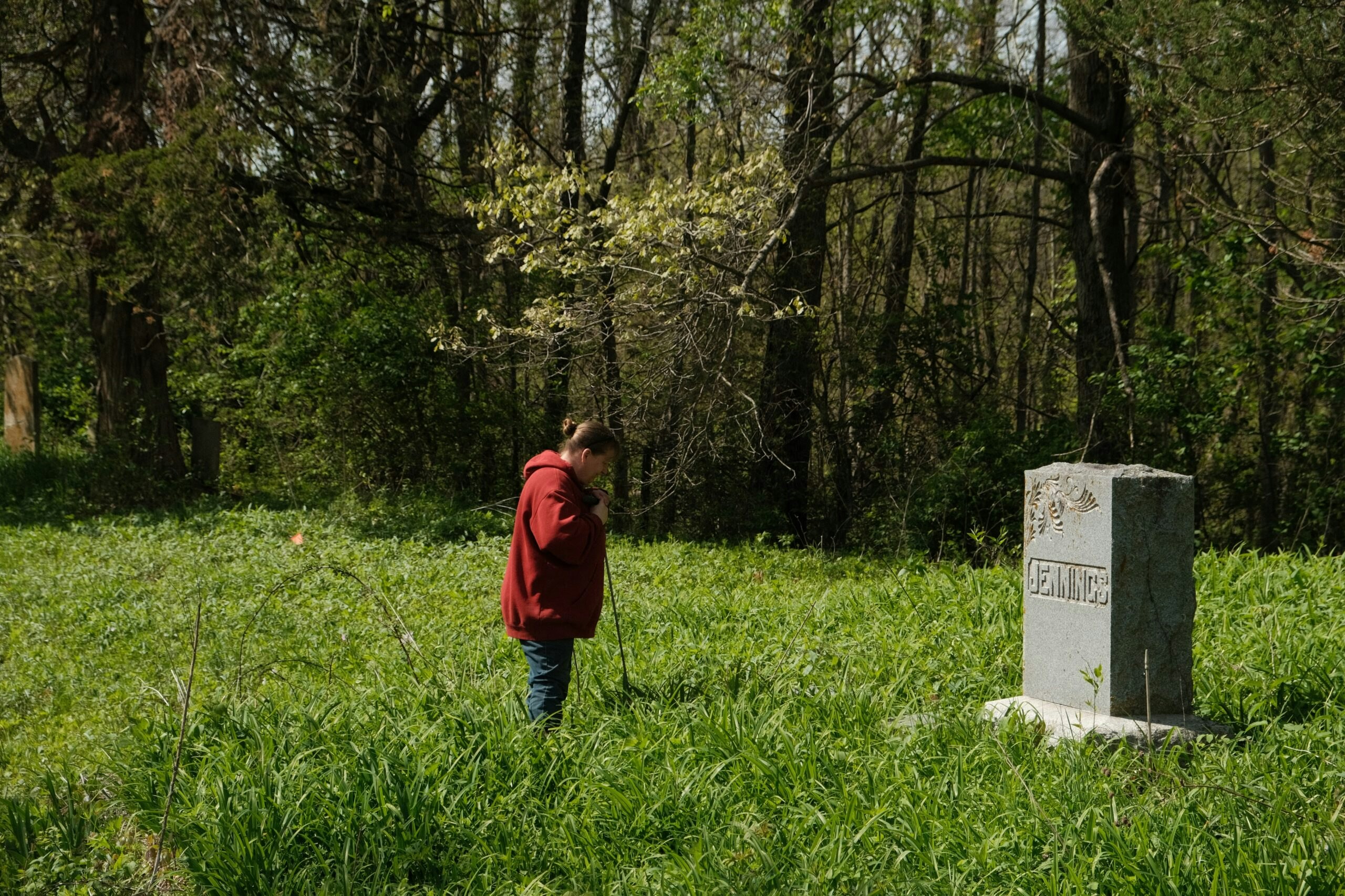
I arrived at the cemetery on a warm Sunday last May. Jacie Thomsen, a Rochester native, greeted me at the gate in a faded U.S. Army T-shirt. A township trustee and the cemetery’s burial manager, Thomsen carried a binder of old documents in one hand and a long metal rod in the other that she periodically used to probe for forgotten, buried gravestones.
“A lot of people tend to say we’re disrespecting our dead,” Thomsen told me. “I always tell people, ‘Take what you think you know about cemeteries and leave it in your car, because it does not, will not, apply here.’”
I think of the postage-stamp perfect square cemetery I grew up visiting on Memorial Day in nearby Wapello, Iowa, with its close-cropped turfgrass, ornamental bushes and stones in lines straight as the corn rows that box them in on all sides. With manicured lawns and trimmed trees as the blueprint for cemeteries, I can see why some less well acquainted with prairie plants — including other township trustees here — complain this place looks “overgrown” with weeds and in need of a good mow. But at the same time, it strikes me that if one of the pioneers buried here suddenly rose from the dead, these hills are about the only part of the Iowa landscape they’d recognize.
“When you walk in these gates, you’re seeing Iowa as they saw it when they arrived after the Black Hawk Purchase,” Thomsen told me, gesturing at the prairie.
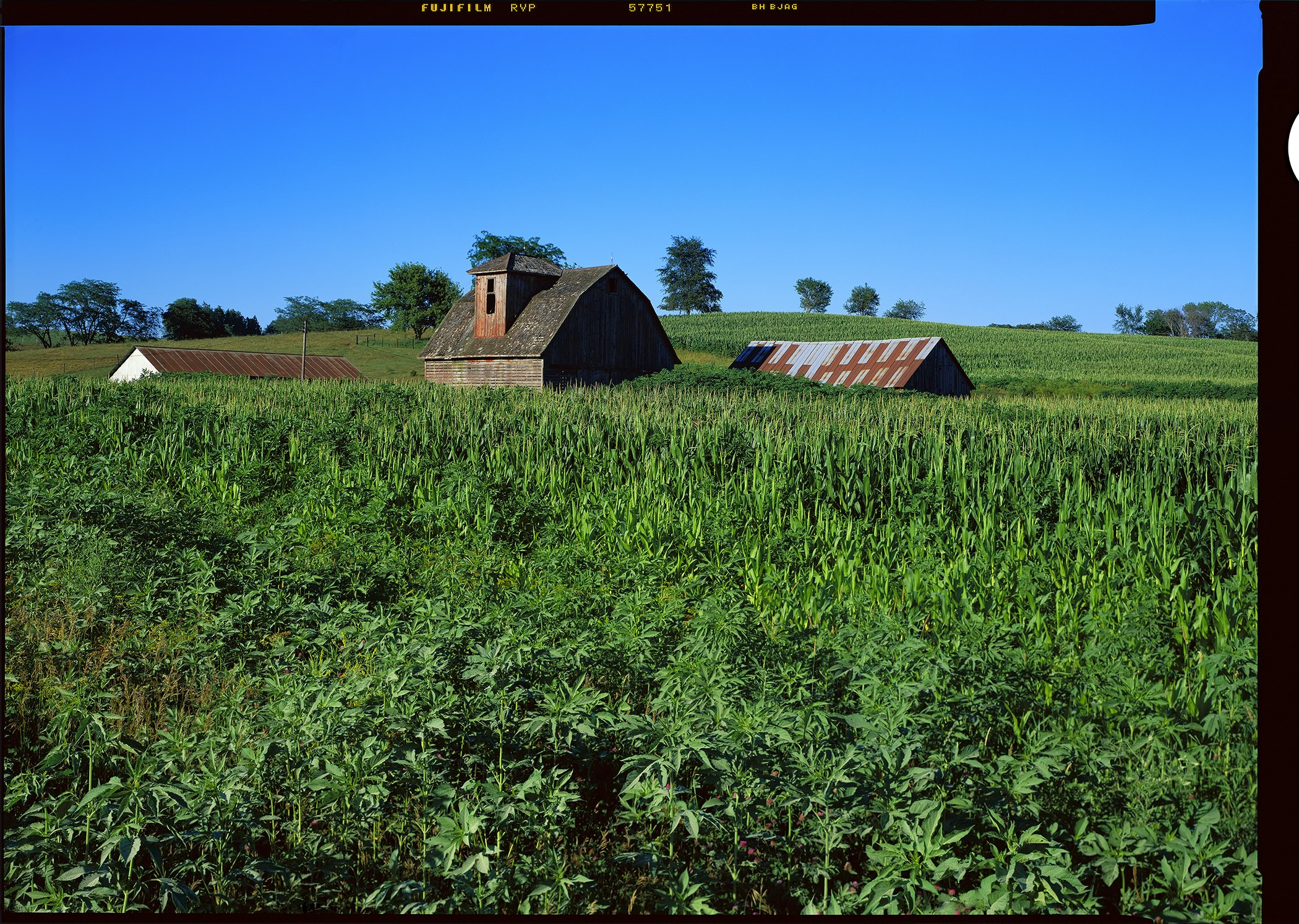
Prairie is Iowa’s natural landscape insofar as any landscape is natural. Humans have shaped the American Midwest ever since the glaciers retreated. For some 10,000 years, Iowa was a dynamic place. Indigenous Americans lit frequent fires that kept encroaching woodlands at bay, allowing the grasslands that dominate the Great Plains to migrate east into Iowa and Illinois. Only in the last 200 years did farmers transform these acres into neat cornfields.
“Turn off a gravel road near the Cedar River in the rural southeast and walk through an ornate rusted arch, and you will find yourself in another world.”
Today, less than a tenth of 1% of Iowa’s original prairie remains. Plows broke the vast majority of prairie down in the 19th and 20th centuries, transforming a biodiverse ecosystem into a crop factory — what Jack Zinnen, an ecologist for the Prairie Research Institute at the University of Illinois Urbana-Champaign, calls an “agricultural desert.” Set aside before industrial agriculture arrived in Iowa, pioneer cemeteries like this one have become the prairie’s final resting place — one of the few where the land remembers what it once was. Some of these cemetery prairie remnants tower over the surrounding farm fields, long roots holding the rich, undisturbed soil together as the rest of Iowa erodes away under repetitive plowing, flowing downriver.
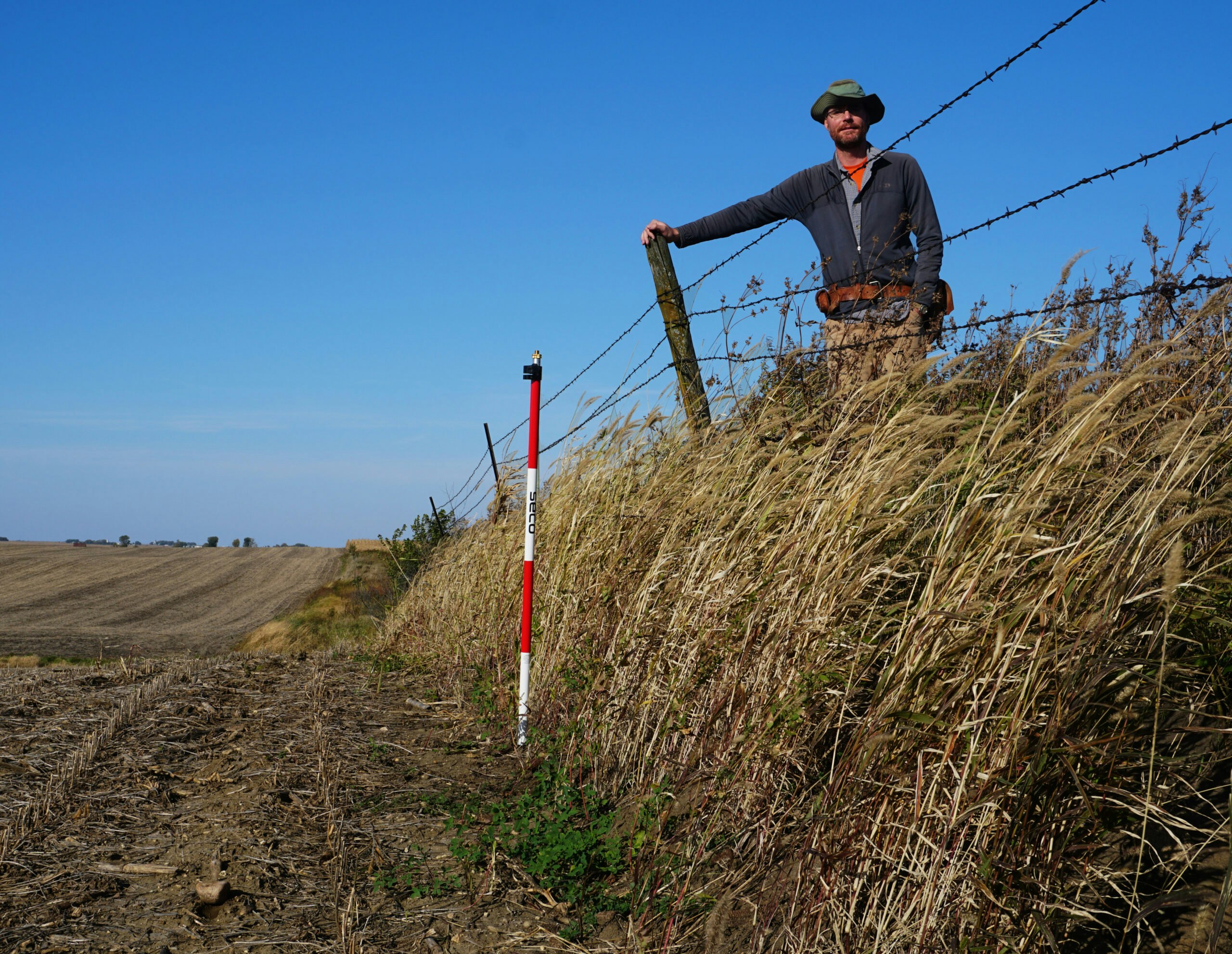
Compared to other forms of American wilderness, prairies are hard to love — they don’t easily fall into the category of the sublime like giant sequoias or Yosemite waterfalls. You have to get really close to appreciate the complex beauty. It’s probably why (along with the black gold underneath the plants) it was so easy to destroy, acre by acre.
“To the uninitiated, the idea of a walk through a prairie might seem to be no more exciting than crossing a field of wheat, a cow pasture, or an unmowed blue-grass lawn,” wrote Robert Betz, a Northeastern Illinois University biologist and early defender of cemetery prairies. “Nothing could be further from the truth.”
Aboveground at Rochester, native prairie grasses and flowers and introduced ornamental plants, such as daisies, hyacinths and showy stonecrops, coexist. Black-eyed Susans, coneflowers, milkweed and prairie clovers grow on graves, alongside the usual decorative plastic varieties. Underground, deep roots entwine with the bodies of long-dead pioneers — who pushed out the Indigenous communities who first stewarded this prairie — and generations of Rochester citizens.
The Prairie’s Unmaking
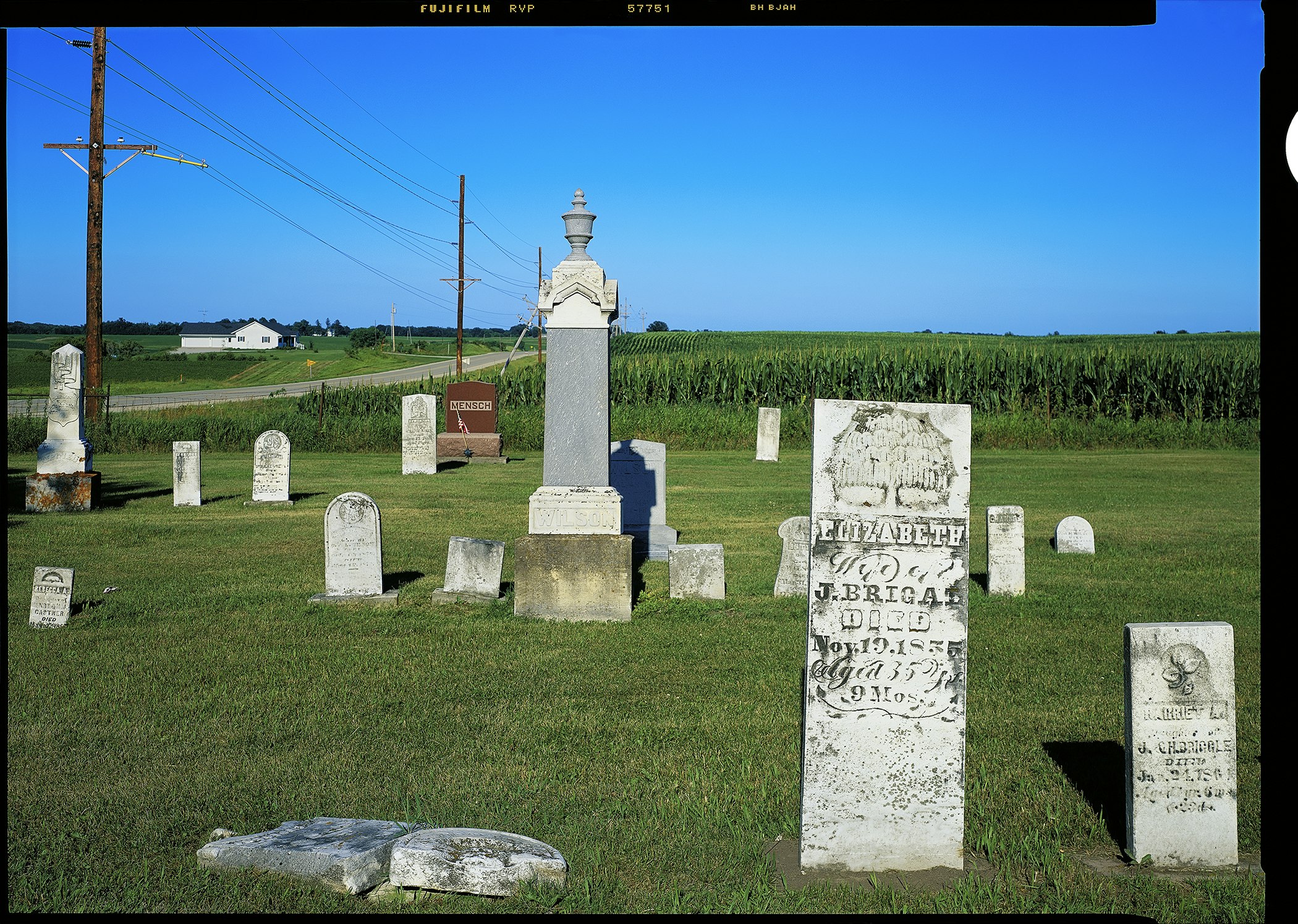
I grew up less than an hour’s drive from Rochester, though I learned of the cemetery’s existence only recently, in a book by the New York landscape photographer Stephen Longmire, who’d stumbled across this place and spent years photographing it with a large format film camera. While he wandered Rochester’s hills in the early 2000s, I was spending my weekends at my grandparents’ farm in Wapello playing in their corn rows behind the barn. Prairie was the setting for Laura Ingalls Wilder’s books, a thing of the past. I had no idea how utterly transformed Iowa was, or how much we’d lost.
It wasn’t until college that I learned the truth. Prairie once stretched from Montana down to Texas and east into Ohio, over a million square miles. Iowa was once the beating heart of the American Central Grassland.
But “tallgrass prairie is, in many respects, a human construct,” Tom Rosburg, a biologist and herbarium curator at Drake University in Iowa, told me.
Prairie relies on annual cleansing fire to transform dead foliage into usable nutrients. Shortgrass prairie in the dry western plains burns easily, the fires often lit by lightning and fueled by constant wind. Tallgrass prairie, on the other hand, “wants to be trees,” Chris Helzer, The Nature Conservancy’s science director in Nebraska, told me. It only grows in places with enough precipitation that woodland should dominate.
The Central Grassland’s extension into the Midwest, called the Prairie Peninsula, puzzled scientists for decades — they wondered why it wasn’t dominated by forest. Eventually, they arrived at an answer. For thousands of years, grass and trees had waged a war of contrition across the hills that are now Rochester Cemetery — and across much of Iowa and Illinois. But Indigenous peoples sided with the grasses from the beginning, lighting regular fires that rejuvenated the grasses, kept trees at bay and ensured the landscape remained open for easier hunting. Here at Rochester, it was the Meskwaki, who still live nearby on land purchased from the U.S. government after the Black Hawk War.
Most of a prairie plant’s biomass is underground, in the form of deep root systems that allow it to spring back to life after frequent fires. When pioneers arrived in Iowa and Illinois in the early 1800s, they discovered millennia of decomposing roots produced a black, nitrogen-rich, silty loam — some of the most fertile soil in the world. Thus began the prairie’s destruction. Industrialized farming operations moved in, like my family’s, such that less than a century later, it was nearly all gone, turned into monocultures of corn and soy sustained by artificial nitrogen inputs, herbicides and pesticides, which were irrigated by stick-straight ditches and networks of buried drainage tiles.
“It was destroyed piece by piece, farmer by farmer,” Rosburg told me, with some bitterness. “It was the biggest transformation in the history of Earth — and in less than a person’s lifetime.”
The change is so dramatic, it’s hard to imagine what was once there. You can’t unplow a prairie — once you tear through those deep, ancient roots, formed over centuries, it’s over. And despite decades of attempts, it’s nearly impossible to create a restoration that perfectly matches the real thing, with its function, structure and sheer number of species, each with its own complex relationships.
“Prairie plants sequester carbon, prevent erosion and provide key habitat for endangered wildlife like Monarch butterflies and rusty-patched bumblebees — ecosystem services desperately needed across the Midwest.”
To attempt a restoration at all, you need raw material — seeds. And for that, you need remnants. Scientists have dedicated their lives to mapping the few places where the prairie still exists, scouring the state on foot and sifting through old records as if panning for gold. Rosburg has found and saved more than 65 forgotten remnants through his organization, Drake Prairie Rescue. Many remnants exist on fragments of land deemed too rocky, sandy or steep to plow. Those remnants were often used as pastures — planted with a mix of non-native grasses and heavily grazed by cattle.
Examples of still-intact prairies, on rich black carbon soil, are rare — primarily found in narrow strips along railroad tracks set aside before plowing began and on pioneer cemeteries, where the impediment to plowing was cultural, rather than practical. Those remnants tend to be the last and best records of what’s considered a typical prairie, with its rich, silty, loamy soil.
To date, there are 136 cemetery prairies across the Midwest, according to the Iowa Prairie Network’s list. While an Iowa cornfield’s species diversity can be counted on one hand, some prairie remnants contain as many as 250 species, according to data published last July by the Prairie Research Institute team in Illinois.
Unlike neighboring Illinois, which has an extensive state system to protect its rare native prairies, wetlands and forests, in Iowa, nearly all the state’s land is privately held. In fact, 60% of Iowa’s public land is made up of roadside rights-of-way, or ditches, as they are more commonly known, according to the University of Northern Iowa’s Tallgrass Prairie Center.
In Iowa, cemeteries with fewer than 12 burials in the past 50 years are officially designated as pioneer cemeteries, which allows counties to relax mowing and restore prairie — although that doesn’t always happen in practice. Still, these township-owned pioneer cemeteries serve as de facto prairie nature preserves, islands of tenuous conservation for rare insects and plants — as long as townships OK it — in a sea of destruction.
Due to climate change, the wet Midwest is becoming even wetter, which means that prairie remnants are slowly transitioning to woodland in the absence of fire. Absent any management, a prairie can disappear in as little as 30 years, Laura Walter, a University of Northern Iowa biologist, told me. “Rescuing” remnants, as Rosburg does, is an active process that involves convincing townships to conduct controlled burns and weed out invasive species in their cemeteries.
And these prairie preserves have come in handy. They’re models for what some scientists call artisanal restorations — small-scale prairies conjured forth on private land, often with great care and dedication to exactly recreating what’s been lost. But remnants like Rochester are also helping bring back prairie at a larger scale.
In the 1990s, Iowa lawmakers mandated prairie plantings along state highways and provided incentives for counties to do the same to help combat soil erosion and reduce mowing and herbicide use that polluted waterways. But the Tallgrass Prairie Center, which operates the state’s roadside vegetation program, couldn’t find prairie seeds readily available for sale.
So, they had to start from scratch, collecting seeds from cemetery prairies and other remnants, learning to germinate and grow plants in their greenhouse and production plots, and then donating seeds to seed companies while teaching them how to grow them in order to scale up production.
Before they started, prairie blazing star, a common Iowa prairie flower, could only be purchased from the Netherlands, where it was a popular cut flower, said Laura Jackson, the Tallgrass Prairie Center’s director. Now, she told me, it’s one of dozens of regional ecotype seeds that counties can use to restore prairie along their roads. At last May’s annual spring seed pickup at the center’s warehouse in Cedar Falls, Iowa, trucks from 46 Iowa counties hauled away 19,000 pounds of prairie seed — big bluestem, switchgrass, prairie clover, asters, coneflowers and more — originally sourced from prairie remnants like Rochester. To date, some 50,000 acres of roadsides have been planted with native grasses and wildflowers.
Restoration is about preparing Iowa for the future rather than trying to revert its landscape to the 1800s, Jackson told me. On a practical level, prairies provide myriad benefits, especially in light of climate change, that are more important than ever, including soil stability, carbon storage, flood mitigation, fire resilience, drought resistance and habitat for pollinators. But because it’s so hard to predict what will survive amid a changing climate, it’s crucial to maximize genetic diversity by sourcing seeds from remnants across the state, Jackson told me.
“Prairie once stretched from Montana down to Texas and east into Ohio, over a million square miles. Iowa was once the beating heart of the American Central Grassland.”
Because Iowa is a relatively young landscape, geologically speaking, only a handful of prairie plants have gone extinct, and most species are still widespread. In parts of the country that haven’t been wiped clean by glaciers as recently, plants have evolved to become highly local, “endemic” to specific niches, Chris Benda, an Illinois botanist who regularly conducts plant surveys, told me.
Even though Iowa’s prairie survives today primarily on scattered fragments, many of its plants once thrived across the state. That means the seeds of Iowa’s great prairie still exist. From pioneer cemeteries, managers can source the original seeds of Iowa’s landscape and use them to grow prairie at scale.
Prairie Or Cemetery?
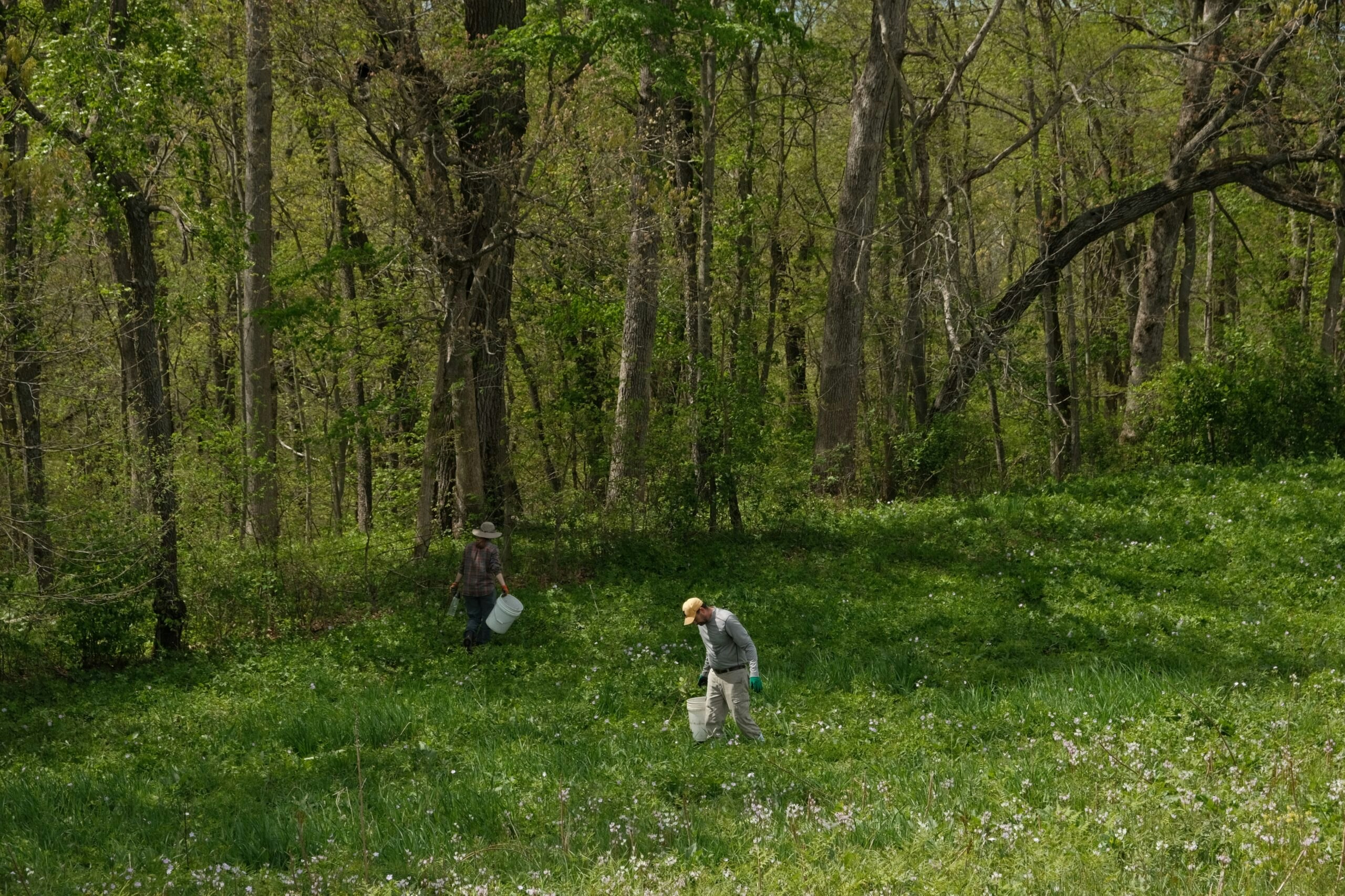
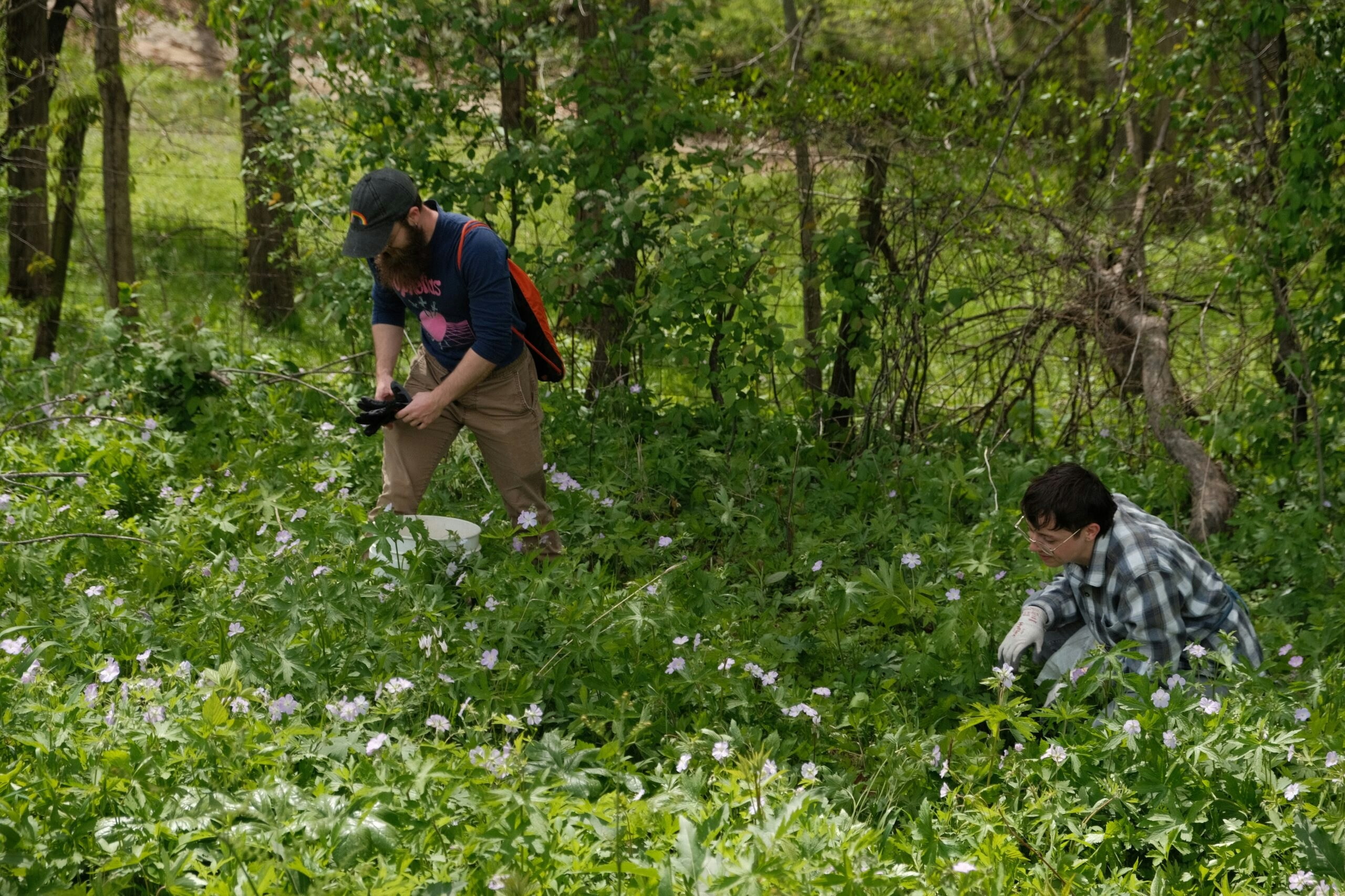
At Rochester Cemetery, others began to arrive for the day’s garlic mustard pull: Dan Sears, an organizer for the nonprofit Iowa Prairie Network; Walter, who runs the prairie plant research program at the Tallgrass Prairie Center; and a dozen locals. Volunteers tucked their jeans into their socks to avoid tick bites, grabbed bags and donned gardening gloves.
Sears explained what garlic mustard — the non-native species encroaching on this tiny prairie remnant — looks like, with toothed leaves and delicate white flowers. However, Sears added that volunteers should also be on the lookout for another non-native plant, showy stonecrop (which he referred to as “sedum”), which could compromise the quality of the prairie remnant.
I noticed Thomsen tense beside me as she piped up: “I need to investigate first before you pull sedum!” The cemetery’s prairie is speckled with sedum and other long-naturalized “invasives,” from lilacs to day lilies, that were planted over centuries to honor loved ones. Thomsen relies on those plants to find unmarked graves in a cemetery without formal records, she told me. She even planted a peony bush to help her find her own family’s graves amid the tallgrass. “Just because you don’t see a headstone does not mean there’s not somebody there!”
Sears held up his hands to Thomsen in surrender: “Her word is law today.”
Their interaction was the first hint at a conflict that has come up time and again here — between what’s considered natural or local, and invasive or foreign, among both plants and people. Rochester draws outsiders to an unusual degree for a rural Iowa town. For years, prairie enthusiasts like Longmire, environmentalists, AmeriCorps volunteers and university scientists have taken the Rochester exit off Interstate 80 to visit this cemetery.
At times, visitors have collected seeds or even plants without permission. The late Diana Horton, who long ran the University of Iowa herbarium and created the most complete list of Rochester’s some 400 species, once cut down several of the prairie’s red cedars, much to Thomsen’s chagrin. The trees are native to the area (“It’s called the Cedar River,” she quipped), but not to oak savannas. Some locals, who come to the cemetery simply to mourn their loved ones, see the outsiders themselves as the invasive species. Of course, it’s a matter of perspective — descendants of pioneers here can trace their ownership back to the original land stolen from the area’s Indigenous peoples.
But the biggest point of conflict, here as at prairie cemeteries across Iowa and Illinois, comes from locals with varying ideas of what a cemetery should be. Rochester Township owns the cemetery, and its trustees manage it, along with most of the town’s affairs. Most of Iowa’s cemetery prairies are no longer active, working cemeteries. That makes it easier for conservationists like Rosburg to make the case to trustees for controlled burns and other active management strategies — the prairie is part of the pioneer history of those cemeteries, something to be preserved. But Rochester still has burials every year, which heightens tensions.
The Nature Conservancy recognized Rochester as a high-quality site for prairie plants back in the 1980s and got permission to do a controlled burn then. But its proposal to cease burials there to prevent damage to prairie plants was “incendiary” to locals, Longmire told me. Since then, fierce debates have arisen repeatedly over proposals to mow more frequently — Thomsen told me that one of her aunts tried to oust an incumbent trustee solely over the need for increased mowing during the 2006 election.
But infrequent mowing is what preserved the prairie. Rochester was hayed for livestock under pioneer ownership and, more recently, due to limited staff time and township funding, mowed annually in the fall so mourners could find their family stones. That cadence mimics the fires and grazing by bison and livestock that historically rejuvenated prairie, keeping woody plants at bay.
“Compared to other forms of American wilderness, prairies are hard to love — they don’t easily fall into the category of the sublime like giant sequoias or Yosemite waterfalls. You have to get really close to appreciate the complex beauty.”
There are always residents who want this cemetery to resemble the familiar urban variety, Sarah Subbert, Cedar County’s naturalist, told me. “Well, that’s not what Iowa was … If you mowed it every week, you wouldn’t have that diversity out there at all.”
Some residents take mowing around their family stones into their own hands, having been officially permitted to do so by management rules enacted in 2016. This has resulted in a more traditional-looking patch of close-cropped grass at the center of the cemetery surrounding the most recent burials, encircled by prairie on all sides — a sort of compromise visible on the landscape.
On Nature & Culture
I fell in love with tallgrass prairie as an undergrad at Augustana College in Rock Island, Illinois. Not with the plants, as many of my botany peers did, but with the idea of prairie as a human construct. If you try to fence off a prairie and preserve it — freeze it in time — it’ll disappear as woody plants and trees slowly encroach. That was a point of fierce debate in the 1980s and ‘90s, when conservationists like Betz, the early discoverer of cemetery prairies, and Steve Packard in Chicago advocated for controlled burns and more active management of prairie remnants and restorations.
Critics saw restoration as gardening or meddling with nature. I thought of the vast western nature preserves that William Cronon described in “The Trouble with Wilderness,” and the irony of the government ousting the area’s Indigenous peoples — who had been stewarding the land — from their homes to create national parks to preserve now government-recognized wilderness. Nature has always been a part of the human realm. But prairie especially so.
“The whole ‘let nature take its course’ thing, or wilderness as a place without people, all those things break down very quickly in the tallgrass prairie,” Helzer, who manages thousands of acres of prairie in Nebraska, told me.
So I started seeking out prairies and other native ecosystems in Iowa and Illinois as a restoration volunteer. I pulled and cut invasives like buckthorn and multiflora rose and helped prepare for burns. When Rock Island decided to reintroduce prairie in a historic, Victorian-style, manicured park near my college, I dedicated my senior thesis to assessing how community members felt about the effort.
What I learned really surprised me — residents used words like “abandoned,” “unkempt,” “trashy” and “unwelcoming” to describe the unmowed areas. Several told me they felt like the “wild” had “invaded” the park and worried about this inviting “vandalism and crime” or “undesirable” people. That’s a conflation — famously made in New York City’s broken windows policing initiative — that some anthropologists have deemed “trash talk.”
To be fair, the initial restorations were of low quality. The parks department, perhaps unfamiliar with the history of prairie management, which requires careful selection and seeding of native species and controlled burns, took a laissez-faire approach. Later, the city acknowledged the “naturalized” areas weren’t exactly beautiful at first and began to plant more prairie grasses and flowers. But the negative attitudes stuck with me, long after I graduated. The nature-culture divide, established over two centuries of American civilization, is a challenge to bridge in the city.
Parks and graveyards are both “memorial landscapes,” Longmire writes in his photography book about Rochester, “Life and Death on the Prairie,” places where nature is manipulated to human ends. But cemeteries are culturally sacred places. That’s why I had to see Rochester’s cemetery prairie for myself. What way forward — if any — had its managers figured out to help with the coexistence of not just plants but also culture?
People Of The Prairie
Back at Rochester, Thomsen led me away from the garlic mustard pull to show me her favorite part of the cemetery. She grew up just to the north and spent her summers here with her best friend, who once eerily foretold that Thomsen would someday become the cemetery’s guardian.
In 2011, the township asked her to become a trustee and the burial manager.
Even setting aside its sprangly prairie vegetation, Rochester is a chaotic sort of cemetery. A resident can pick a plot, but that doesn’t guarantee it will be available. (“Somebody might already be there,” Thomsen told me.) On a metal park bench under an oak, Thomsen unrolled a copy of a survey from the 1980s with graves marked with little Xs: “It’s accurate to a degree,” she said.
“Most of a prairie plant’s biomass is underground, in the form of deep root systems that allow it to spring back to life after frequent fires.”
Thomsen’s found hundreds of unmarked graves with her trusty prod and dug up and restored many broken and long-forgotten stones — as of December 2025, she was up to 1,061. And after 15 years, she knows where all her “residents” are — and all their stories. She’s met their descendants and walked with them to their long-lost relatives. She’s dug through newspaper archives for obituaries and uploaded records to FindAGrave.com. Growing up, she wanted to be an archaeologist.
Surefooted in the tall grass, Thomsen led the way uphill to a spot near the cemetery’s boundary fence, far from the mustard-pulling crew. Here we visited Rebecca Green, who died on Sept. 25, 1838, at the age of seven months. This made her grave the cemetery’s oldest, Thomsen told me. Green is surrounded by pink prairie phlox and purple columbine, as she would have been when her parents, Eliza and William Green, buried her here next to where they’d eventually be laid to rest. Thomsen wondered aloud if they’d picked this place for its colorful flowers. The Greens arrived in Rochester in 1837, just a year after its founding, from Kentucky and Maryland, respectively. Their home served as a hotel for travelers and a stop on the underground railroad.
“When you come here, you’re looking at what they saw and what made them stay,” Thomsen told me. “This is the pioneer’s gift that they left for us. We are respecting that, even if everybody doesn’t get it, when they’re so used to manicured, boring.” She’s protective of this place, and her job isn’t easy. Sometimes trustees make decisions without her, mowing too early last year, for example, which prevented a controlled burn she was planning. She’s used to having to fight to be heard. She yanks poison ivy off a newer stone that reads “Captain Andrew Walker” — a Mexican and Civil War veteran buried in “a pauper’s grave” after he died at the Mt. Pleasant Asylum for the Insane. Thomsen tracked down his pension file and honored him with a stone on his family’s plot at Rochester.
I asked Thomsen whether she knew where she wanted to be buried. And of course, she did. She’s known since she was a child. The highest hill along the back fence, under an oak — a spot that’s always called to her. Thomsen gets goosebumps thinking about it. “There’s energy to the land, and we all leave our little imprint somehow.” The cemetery remembers the prairie, and the prairie remembers the people buried within it. Like the Greens, Thomsen’s family is mostly here, “four rows of kin” — her grandma and grandpa, her aunt, three uncles, her sister-in-law, two of those lost just last year. Her own staked-out spot is some distance away from the family plot — “Sometimes you can be a little too close to family, even in death.”
When Longmire spent his years in Rochester, he lamented that there was a “dearth of people who could see both sides of the coin,” he told me — to appreciate Rochester as both a natural and cultural wonder. But just as he left, Thomsen arrived on the scene. In her big binder, she keeps a pamphlet from his book talk. She knows all the stones, but she also knows the prairie — the common names (and some she’s made up) for each of the plants and the spots they come up every year, including the secret place the lady slipper orchid grows. She knows each of the towering oaks by name — the bear tree (a burr oak with a burr that resembles a cub climbing one side); the guardian, which stood tallest on the hill before a derecho felled it. She cried and mourned its death.
I had expected conflict at Rochester. But instead, I found someone who cared enough to shepherd compromise. If it can be done here, on hallowed ground, maybe it can be done anywhere.
Life Persists
Lost in thought, I realized Thomsen had taken off down the hill. I waded after her. She wanted to point out a new plant she’d spotted to Sears, the mustard pull organizer. Each little stalk was ringed with a spiraling firework of yellow blossoms.
“Oh, that’s lousewort!” he told her, “Laura would be really excited to see that!”
Thomsen cupped her hands around her mouth and shouted for Laura Walter.
“The cemetery remembers the prairie, and the prairie remembers the people buried within it.”
Walter, the scientist, wandered over, a bag overflowing with uprooted garlic mustard invaders tied around her waist. She excitedly knelt to examine the tiny plant, lifting her wide-brimmed hat. Finding lousewort usually means you’re dealing with high-quality remnant prairie, she told me, a “holy grail.” It’s partially parasitic, with roots that penetrate those of other plants underground to pirate water and mineral nutrients. In doing so, it suppresses its victim’s growth and keeps the prairie more open, promoting diversity. That kind of complex relationship is hard to recreate when doing restoration work. The plants nearby did look a little droopy. Had it already raided their nutrients and left a warning sign for others? I asked.
“It’s tantalizing to think about,” Walter laughed. She took a geolocated photo, and later, with the township’s permission, returned to collect its seeds.
Walter then pointed excitedly at a blooming shooting star a few feet away. As we watched, a large bumblebee hovered upside down under its blossom and landed. In the spring, new bumblebee queens fly great distances to start new colonies, she told me. They depend on a few early blooming prairie flower species, like the shooting star, which have co-evolved to release pollen at specific bumblebee buzz frequencies.
“It’s funny, this is a cemetery, it’s where you honor the dead,” she mused. “But here you can also come and honor an abundance of life.”
Walter has collected shooting star seeds from remnants across the state, but they’re tricky to propagate. In the first growing season, a plant produces tiny seed leaves, a centimeter across. The following year, it gains a tiny tuft of true leaves. It can take five years to flower and produce seeds. Prairie restoration managers typically favor vigorous, fast-growing species that can outcompete invasive species and establish quickly.
Sitting in a prairie, you come to appreciate its beauty. The sheer complexity surrounding us was overwhelming. And it continued, invisibly, beneath the soil — every remnant prairie has a fungal and microorganism community unique to the soil type and plant community.
“Think about all the things that we don’t know, and that don’t come back on their own,” Walter said. “We have to preserve those relationships in the places where they exist until we understand them.”
Fate Of The Prairie
The future of tallgrass prairie remains uncertain. The Midwestern states are speckled with more and higher-quality restorations today than when efforts began in the 1980s; however, Iowa’s unique roadside vegetation program depends on county and state-level support, which is at a low point under the current administration.
The Burr Oak Land Trust, an Iowa conservation group that for years sent AmeriCorps volunteers to Rochester and other remnant prairies to pull invasive species and conduct prescribed burns, lost its funding due to Department of Government Efficiency cuts this year. The Prairie Research Institute in Illinois lost $21 million in federal funding last fall. And opt-in programs, like the Conservation Reserve Program, where the federal government pays farmers to take marginal land out of crop production and return it to prairie or wetland, depend on the whims of the market, Jonathan Dahlem, an Iowa State University sociologist who studies farming conservation practices, told me. When corn and soybean prices rise, like they have over the past two decades, farmers are eager to plow up restorations to seed row crops even if yields aren’t expected to be high.
Rosburg said he finds hope in the increasing number of remnants discovered each year on forgotten pastures, along roads and in cemeteries. Universities like to talk about the “outsized impact” of small restorations, Jackson told me. But in reality, “every little bit helps a little bit,” she said.
I find my own hope in this place and in these people. At the end of the day, after the garlic mustard pull was over, Thomsen and Walter walked together up the hills, sharing their intimate and yet very different knowledge of the place.
Longmire calls Rochester Cemetery a memento mori — a reminder for living visitors of both their inevitable fate and of what Iowa lost. Funerals, gravestones and cemeteries are for the living — and this is a place that is alive, with plants and humans. Rochester is a time capsule of the past and a key to the future.
As I left, a truck and trailer pulled into the prairie to unload a riding lawn mower. The roar of the engine drowned out the buzz of insects as its operator carefully mowed around their family stone. It’s not a sight you’d see in a typical prairie. But here, it’s what compromise looks – and sounds — like.
I later learned that the man who had mowed around the gravestones of many Rochester families for years as a public service had passed away that same day. The sea of tallgrass grew unchecked in the following months, surging against the gravestones like waves — a constant reminder that he was gone. Concerned families have started asking Thomsen how the cemetery will be maintained going forward — how nature will be held at bay. A similar series of events sparked the big fight over mowing back in 2006. I worry a little about the prairie’s future and Thomsen’s hold over the fragile balance here.
“But isn’t it wonderful,” Longmire asked me, “to have a place that people take so seriously to fight about how it’s managed?”


